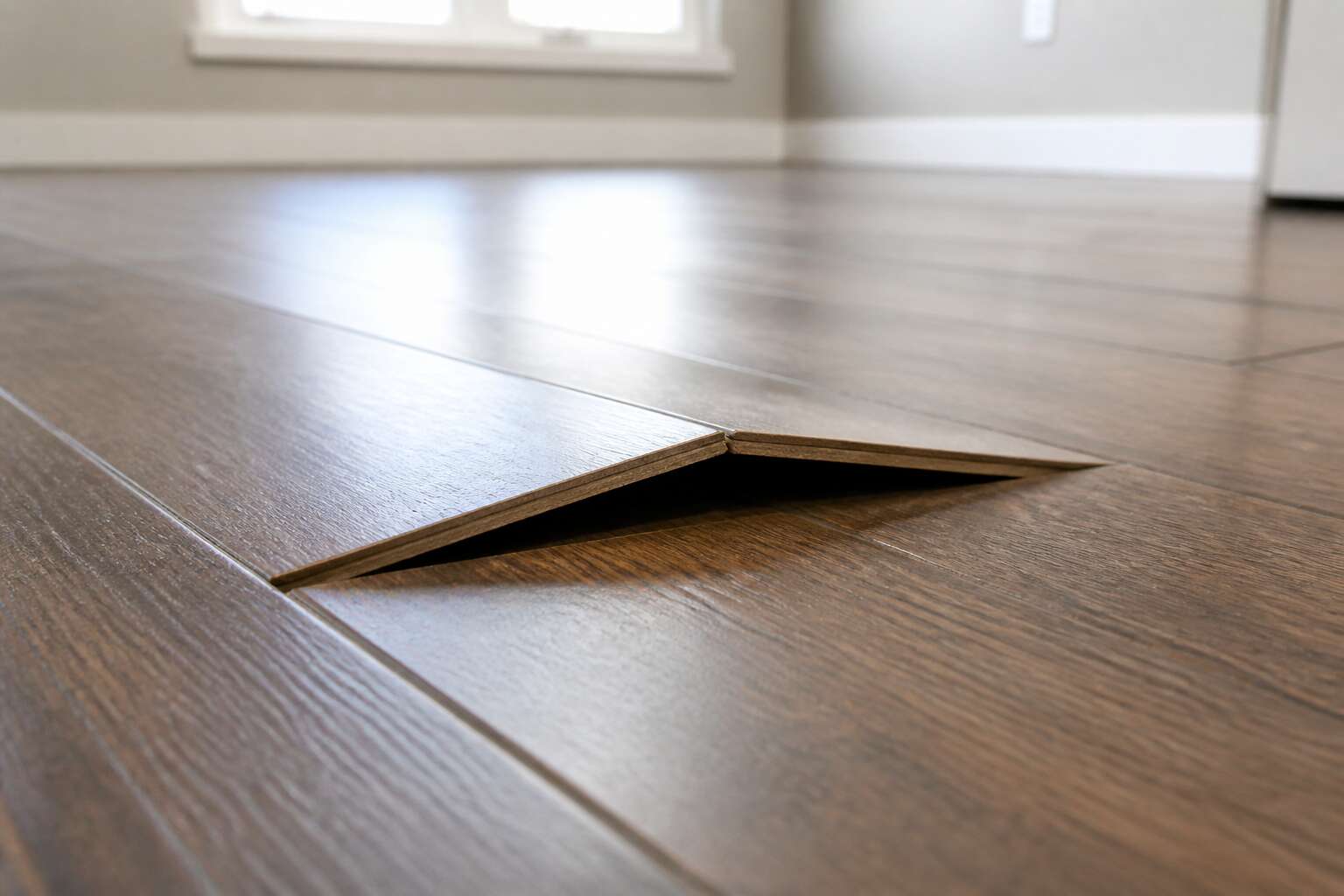
Understanding Why Laminate Flooring Lifts
The Anatomy of a Laminate Floor
Nothing upsets a room’s rhythm quite like a laminate floor keeps lifting along its edges. To understand this failure, you must first grasp the anatomy of a laminate floor. It is a layered system: a stabilising backing, a high-density fibreboard core, a printed design layer, and a tough wear layer on top.
- The core absorbs ambient moisture and swells.
- The backing and wear layer resist water but cannot stop sidewards movement.
That swelling core is the primary culprit. As the fibres expand, the floor buckles upward, especially near seams. The design layer and wear layer remain intact, but the core’s growth forces the whole plank to lift. Without an expansion gap, adjoining boards compress against each other, turning a minor swell into an obvious hump.
How Lifting Affects Both Aesthetics and Safety
In Johannesburg’s dry winters and Durban’s humid summers, I have seen cases where laminate floor keeps lifting in homes across income brackets. The cause rarely sits in the core alone. Uneven subfloors and misaligned door frames create force points. The locking joints fatigue and release under daily weight.
The aesthetic damage is immediate. Raised edges break the continuous plane, and light casts small shadows along every seam. Safety concerns grow as well. A lifted corner catches heels, pet claws, and pram wheels.
- Raised planks create fall risks for older adults
- The gap beneath collects crumbs and moisture
- Sharp edges cut through soft socks
Each step on a warped board adds stress to neighbouring planks. In households with toddlers or elderly members, this becomes a functional hazard.
Why Lifting Is Not Just a Cosmetic Issue
In my years inspecting floors across South Africa, I have found that the true culprit behind a laminate floor keeps lifting often remains hidden until the boards are pulled apart. The stress begins long before the first footstep lands on the surface. Moisture vapour from the concrete slab below, combined with seasonal shifts in humidity, creates a silent pressure that pushes against the locking system from underneath. This is not a defect in the material itself, it is a reaction to the environment.
The expansion gap is where the story starts to unfold. When installers leave too little room along the perimeter for natural movement, the boards have nowhere to go. They press against the walls, and the tension transfers to the joints. You may notice the lifting first near doorways or heavy furniture, but the origin is always the same. Without adequate space, the planks buckle in the only direction they can, upwards. In my experience, a laminate floor keeps lifting for one primary reason: the environment and the installation did not account for each other.
Installation errors compound the problem. An underlayment that traps moisture instead of releasing it acts like a sponge against the board’s underside.
– Uneven subfloors create low spots that allow planks to flex
– Misaligned door frames force cuts that compromise the locking edges
– Insufficient acclimation time leaves the boards swollen before they are even laid
These factors, when combined with the South African climate, set the stage for failure. The lifting you see on the surface is simply the final act of a sequence that began days or weeks earlier.
Common Causes of Lifting in Laminate Floors
Moisture and Humidity Fluctuations
Humidity in Durban is a worthy adversary. The moment moisture slips through the seams, the high-density fibreboard core absorbs it like a sponge. Swelling has to go somewhere, and your laminate floor keeps lifting as a direct result. Spills left for twenty minutes become entry points. Coastal air behaves predictably, but only in its determination to wreak havoc.
- Spills not wiped within 15 minutes
- Wet mopping instead of a barely damp cloth
- Humidity levels above 70% without a dehumidifier
In Gauteng, the swing between hot days and cool nights creates condensation under the boards. That trapped moisture forces the locking systems apart. Either way, the failure starts at ground level, and your laminate floor keeps lifting until the underlying moisture problem is addressed.
Improper Acclimation Before Installation
No amount of precise leveling saves a floor that never adjusted to its new home. Acclimation is the quiet, tedious step that installers skip when the client wants the job done before the weekend. The boards need time to breathe, to settle into the temperature and moisture of the room where they will live. The accepted standard is at least 72 hours, spread out in the actual room, not leaning against a hallway wall.
When that waiting period is ignored, the boards respond later. They expand as they finally adapt to the environment, and that expansion has nowhere to go. The locking systems take the pressure and the seams start to strain. In South Africa, the extremes are part of the problem. A Johannesburg morning can be crisp, the afternoon scorching, and the evening cool enough for a jersey.
Rushed installation leaves little room for this daily swing. The symptoms appear within the first few months:
- An uneven surface where the boards meet
- Gaps that appear and close with the weather
- A subtle popping sound when you walk across the room
The core issue is timing. The boards should do their expanding and contracting before they are locked together, not after. If they are forced into place too soon, your laminate floor keeps lifting because the expansion was built into the installation. The fix is never simple once the boards are down. It starts with giving the wood its time, before the first plank is ever clicked into place.
Lack of Expansion Gaps Around the Perimeter
Expansion gaps are the floor’s allocated space to move, and in South African homes they are often overlooked during a rushed installation. The perimeter needs a margin of 10 to 12 millimetres for the boards to move when they swell.
Skip that margin and the boards press against the skirting. I have repaired this exact problem in Johannesburg homes. Pressure builds along the walls and transfers to the locking systems in the middle of the room. Within months, your laminate floor keeps lifting, not along the edge, but in the centre where the seams buckle upward.
The gaps disappear for predictable reasons:
- Skirting boards fixed too low, covering the required margin
- Door frames cut flush with the flooring
- Heavy furniture pushed against the walls before the floor settles
Each one removes the buffer the floor relies on. Without that buffer, your laminate floor keeps lifting whenever the temperature shifts.
Subfloor Irregularities and Uneven Surfaces
In South African homes, the subfloor is often a concrete slab with a mind of its own. It may appear level to the untrained eye, but appearance can be misleading. A spirit level will reveal the truth: dips and ridges, sometimes spanning only a few centimetres, sometimes stretching across the entire room.
When laminate is laid over such a surface, it tries to follow every contour. The locking systems bear the burden of this unevenness. Within months, the seams begin to strain, and your laminate floor keeps lifting around the irregular spots. The underlay provides a measure of forgiveness, but it cannot correct significant deviations.
- Uneven screeding that was never properly levelled
- Old adhesive residue left behind from previous flooring
- Warped wooden floorboards beneath the laminate
Each of these creates a localised pressure point that the boards were never designed to handle. What begins as a subtle give underfoot soon becomes a visible, stubborn buckle.
How to Diagnose the Root Cause of Lifting
Inspecting for Moisture Damage and Water Intrusion
Begin with a simple touch! When a laminate floor keeps lifting, place your palm flat against the planks near the skirting. Dampness or a cooler temperature reveals moisture before any visible stain appears. Then move to the subfloor. Use a moisture meter to measure the slab, especially after a night of rain. These readings tell you if water comes from above or below.
Inspect the most telling areas:
- Expansion gaps filled with debris that hold water.
- Thresholds where a leaky roof could drip.
- Pipe penetrations through the concrete.
A higher reading in one section points to a specific intrusion point. Tracing that pattern of water stops the floor from lifting further.
Checking Expansion Gaps and Transition Strips
Expansion gaps rarely receive attention until the damage is visible. When you observe a laminate floor keeps lifting, inspect these narrow channels first. Use a thin tool, like a feeler gauge, to probe along the baseboard. Any debris packed inside prevents the floor from expanding during heat and humidity. The result is upward pressure that manifests as lifting.
Transition strips offer a secondary clue. These pieces straddle thresholds and doorways. Pay attention to how they sit:
- Warped edges often mean trapped moisture.
- Uneven height across the strip signals subfloor movement.
- Tight screws that pierce the plank will lock expansion.
I always check the strip’s underside for compression marks. A strip that appears recently sanded or painted suggests someone tried to hide a persistent issue. That cosmetic cover-up rarely addresses the root cause of the lift!
Evaluating Subfloor Levelness and Condition
The subfloor holds secrets beneath the surface. When a laminate floor keeps lifting, the ground itself often betrays the structure. Uneven screed, damp patches, or failing particle board create silent pressure points. I probe with a spirit level and a straightedge, tracing every hollow and ridge.
Key indicators:
– soft spots that yield underfoot
– crumbling or powdery concrete
– visible tide marks from past flooding
These signs reveal where support has died. The subfloor’s condition dictates how well the laminate can breathe. Ignore it, and the lift returns like a persistent ghost.
Identifying Installation Errors and Defective Planks
Diagnosing why a laminate floor keeps lifting requires looking beyond the surface to the installation itself. I check how the planks lock together at every seam. Gaps between joints signal a locking system forced together at the wrong angle. Curved or bowed planks often indicate defective stock that passed through quality control.
Common installation errors I encounter:
- Planks hammered instead of tapped with a pull bar
- Skipped spacers along walls and doorframes
- Rows started without staggering the end joints properly
Defective planks reveal themselves through clicking sounds underfoot or edges that sit slightly higher than their neighbours. A laminate floor keeps lifting when the click-lock profile fails to seat fully, creating tension that pushes rows apart. The damage usually shows first near doorways where foot traffic concentrates. When a laminate floor keeps lifting in these patterns, the culprit is almost always the installation method or the planks themselves.
Step-by-Step Fixes for Lifting Laminate Floors
Method 1: Re-Seating Lifted Planks and Replacing Damaged Pieces
Ever walked barefoot across your floor and felt a plank shift underfoot? That unsettling movement is your laminate floor keeps lifting, and it demands attention before it becomes a genuine hazard. When laminate floor keeps lifting in one spot, I have found the repair is straightforward, but it requires patience.
The first fix involves coaxing the wandering plank back into position. Slide a putty knife between the lifted edge and its neighbour to release the locking mechanism. Apply wood glue to the groove, then press the plank down firmly. A weighted stack of books works wonders here!
For damaged pieces, replacement is non-negotiable.
Here is the simple sequence:
1. Cut a circular saw line through the centre of the ruined plank.
2. Pry out the middle section, then the edges.
3. Click in the new plank at an angle and tap it level.
Assess the nearby rows first, since a single problem plank often indicates a broader installation fault underneath. Addressing the plank without fixing the cause means this returns.
Method 2: Adjusting Expansion Gaps and Trimming Excess Material
In many South African homes, the culprit behind a laminate floor keeps lifting is hidden in plain sight: the expansion gap. When boards are installed flush against walls, they have nowhere to go as temperatures change. The floor responds by bowing upward.
The remedy is straightforward. I carefully remove the skirting or quarter round to expose the edge. Then I measure the gap. It should be at least 10 millimetres from the wall. If it is too tight, I trim the boards with a circular saw.
Transition strips often hide the same problem. Check them too, and file down any that press against the planks. Giving the floor room to breathe prevents recurrence.
Method 3: Using Weight and Clamps to Flatten Warped Boards
When a section of your laminate floor keeps lifting, the boards themselves may be the guilty party. Warped planks hold a memory of moisture, curling upward at the edges like something resenting its confinement. I have found that heavy weights and clamps can coax them back into submission, though patience is the true currency here.
Place a straight edge across the raised board to confirm the warp. Then lay a damp cloth over the area and apply heat from an iron. The moisture softens the fibreboard, making it pliable. Immediately clamp the board down flat, using a long board as a spreader to distribute pressure evenly.
Here is the sequence I follow:
1. Test the warp with a straight edge.
2. Dampen a cloth and iron over the affected plank.
3. Clamp with even pressure.
4. Leave for 24 hours.
Leave the clamps in place for a full day. If your laminate floor keeps lifting after this, the core has likely delaminated. Replacement is the only honest answer, and I would rather tell you that plainly than sell you false hope.
Method 4: Addressing Moisture Problems with Barriers and Sealants
Coastal South Africa brings airborne moisture that creeps into unseen gaps. That invisible intrusion leads to swelling, and soon your laminate floor keeps lifting despite every previous repair. A barrier stops the problem before it starts.
Apply a flexible polyurethane sealant along the seams and around edges. This seals the vulnerable zones where water typically enters. For extra protection, lay a polyethylene vapour barrier over concrete subfloors before reinstalling planks.
- Clean the affected area thoroughly.
- Run sealant bead along every seam.
- Smooth with a finger or tool.
- Allow full curing for 24 hours.
Remember that this method only works when the source is external moisture. If you tackle the cause, you will avoid the recurring frustration.
Method 5: When to Call a Professional Installer
Attempts at repair have their limits. When your laminate floor keeps lifting after multiple interventions, the problem may lie beyond what a weekend toolkit can solve. A professional installer brings moisture meters and laser levels that reveal hidden causes. If the subfloor base is inconsistent, or the planks suffered damage during installation, expert assessment separates the curable from the unfixable.
I have seen homeowners spend months fighting a single bump, only to learn that poor locking mechanisms affected an entire batch. That is not incompetence. Some issues demand experience.
Consider calling a professional when:
- The same section lifts after every repair
- Gaps reappear after trimming and sealing
- You suspect a defect within the planks themselves
A professional also knows when the laminate floor keeps lifting because of structural movement, which no surface fix can address.
Preventing Future Lifting Issues
Acclimating Planks Properly Before Installation
Prevention starts with a simple ritual: letting the planks breathe before they ever touch the subfloor. Acclimation is a deliberate pause in the installation timeline, and it directly determines whether your laminate floor keeps lifting months later. The room itself must be the conditioning area, not a garage or a passage.
Lay the boards flat inside the target room, open the cartons, and cross-stack the planks. This exposes every surface to the existing air. Keep the environment stable for at least 48 hours; in humid coastal regions, stretch that window to 72 hours.
- Switch off underfloor heating during the acclimation period.
- Close all windows to prevent sudden moisture swings.
- Check the moisture content of the planks with a meter, aiming for consistency across batches.
Once the boards match the room’s ambient humidity, they will resist swelling and buckling. A disciplined acclimation routine is a strong safeguard. If you ever wonder why your laminate floor keeps lifting, review your preparation first.
Maintaining Consistent Indoor Humidity Levels
South Africa’s climate is a study in extremes. Coastal humidity can spike without warning, while inland winters turn air bone dry. These swings directly influence whether your laminate floor keeps lifting. The fix starts with a simple habit: keep the indoor relative humidity stable, ideally between 40% and 60%. A cheap hygrometer gives you a constant readout. When levels drift, act before the planks react.
Routine matters more than perfection. In Durban, run a dehumidifier during sticky summers. In Johannesburg, use a humidifier during winter’s dry spells. Consistency prevents the micro-expansion that warps edges and pops locks.
- Check humidity readings weekly.
- Correct levels in 10% increments, never abruptly.
- Keep thermostats steady, avoid overnight drops.
Monitor the same way you check your car’s oil. A stable room means a stable floor. If your laminate floor keeps lifting, inspect your home’s air before you inspect the planks.
Using High-Quality Underlayment and Moisture Barriers
Most floor failures begin beneath the visible planks. A quality moisture barrier prevents rising damp from warping your floor’s core. Without it, that laminate floor keeps lifting every time humidity spikes.
Choose a barrier with a polyethylene film or built-in vapor shield. Pair it with foam underlayment that absorbs subfloor imperfections. I’ve seen floors last twice as long when the owner spends a few extra rand upfront. Cheap underlayment saves money once, then costs you twice in repairs!
- Sealed seams that block vapor flow
- Overlaps of at least 20 centimeters
- Wall rises of 5 centimeters for edge coverage
A continuous barrier without tears is essential. Subfloor moisture levels demand a barrier rated for concrete slabs. That specification eliminates the most common reason a laminate floor keeps lifting after rainy seasons.
Periodic Maintenance and Cleaning Tips
Your laminate floor keeps lifting when maintenance habits allow moisture to reach the core through damaged surfaces. A regular cleaning routine catches small problems before they escalate. Sweep or vacuum weekly to remove grit that scratches the wear layer. When grit scratches through, moisture reaches the core.
I recommend damp mopping with a laminate-specific cleaner, never a soaking wet one. Excess water pools in seams and seeps under planks. Wipe spills immediately! Even a few minutes of standing water can penetrate joints.
Check your cleaning products too. Wax and polish leave residue that traps humidity against the surface. Stick to pH-neutral solutions designed for laminate.
- Wipe up spills within five minutes
- Damp mop only, never wet mop
- Vacuum with a soft brush attachment
- Place mats at entryways to trap grit
Lift furniture when moving it. Dragging gouges the surface and exposes the core. Those scratches become moisture entry points, and before long, your laminate floor keeps lifting once more.
Extending the Lifespan of Your Laminate Floor
In my experience, a floor announces its distress long before it becomes a visible hazard. A slight hollow sound underfoot, a fine seam catching the light where no seam should be. Catching these early signs is the difference between a fifteen minute repair and a full section replacement. Your laminate floor keeps lifting when small warnings are ignored, so take every change in texture seriously.
Consider the spaces beneath your furniture and along the perimeter. Leave room for the floor to expand and contract. Heavy pieces pressed against an edge restrict movement, and pressure builds until your laminate floor keeps lifting at the edges.
- Check seams and joints monthly with a flashlight.
- Keep underfloor vents clear and unobstructed.
- Seal nicks and scratches the day they appear.
Prevention is quieter than repair. A floor that moves freely and receives attention at the first sign of change will hold its planks steady.




0 Comments