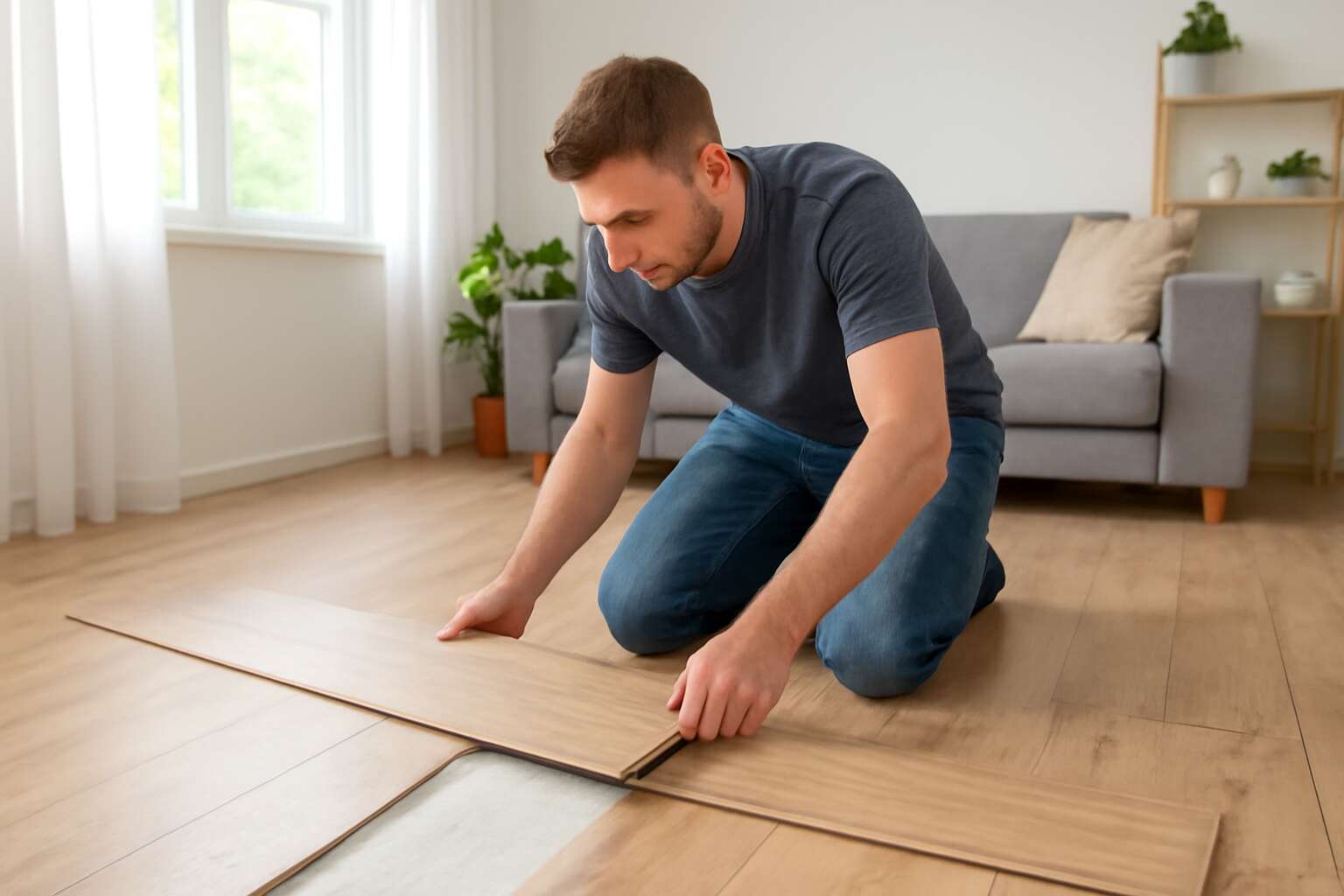
Understanding laminate flooring basics
What laminate flooring is and how it works
Flooring is the living memory of a room, and in South Africa, most homeowners want a quick, affordable upgrade. Recent surveys show more than half prioritise speed and cost when redoing floors, a reality laminate flooring often meets with surprising ease.
Understanding what laminate actually is helps answer the question is laminate flooring easy to install. It’s a multi-layer product: a durable wear layer, a high-resolution image that mimics wood, a dense HDF core, and a stabilising backing. A simple click-lock system can speed things along, but good subfloor prep matters.
In practice, choosing the right underlay, measuring for expansion gaps, and using the right locking system reduces waste and issues on install day. For many, the question becomes less about capability and more about prep and expectations.
- underlay choice
- expansion gaps
- lock-and-click vs glue-down
- subfloor cleanliness
Key layers and construction
Flooring isn’t just covering for feet; it’s a room’s memory. In South Africa, 62% of homeowners want a quick upgrade with lasting impact. People often ask, is laminate flooring easy to install, and the answer reveals itself in the layup of its layers. When you listen closely, the promise is not speed alone but endurance—resilience that breathes with daily life and the sawdust of a busy household.
Key layers underpin that promise. Consider how each sheet is built:
- Wear layer: protection against scratches and foot traffic.
- Image layer: a high-resolution print that mimics genuine wood.
- HDF core: a dense, stable panel that resists pressure shifts.
- Backing: a stabilising sheet for moisture management and ride quality.
Ultimately, the ease of installation isn’t a single act but a choreography of expectations. When the layers align with a room’s character, the floor becomes more than surface—it reveals how we inhabit space.
Visual styles and wear layers
Across South Africa, 62% of homeowners crave a quick upgrade with lasting flair. People ask, is laminate flooring easy to install, and the answer unfolds in the hush between boards—where design and practicality meet.
Visual styles turn plain planks into rooms that speak. Subdued graining, sun-kissed blondes, or rugged textures mimic timber without the upkeep. Consider these visual styles:
- Natural timber grain looks
- Matte and satin finishes
- Stone-inspired textures
When the surface visuals align with a space’s light and flow, the room tells its own story—the kind of story that makes installation feel effortless, even in a busy household.
Laminate versus alternative flooring options
Across South Africa, 62% of homeowners crave a quick upgrade with lasting flair. Understanding laminate flooring basics helps you picture a transformation that blends ease with elegance. It’s a flooring choice that promises quick installation without sacrificing style.
People frequently ask is laminate flooring easy to install, and the hush between boards reveals design’s approachable side—tongue-and-groove seams click, subfloors stay predictable, and your time is saved.
When weighing laminate against alternatives, consider durability, moisture resistance, and aesthetics.
- Engineered wood
- Luxury vinyl plank
- Ceramic tile
Planning the installation
Room preparation and layout
South African homes are defined by more than walls—the floor sets the mood. A recent survey shows 72% of buyers notice floor layout before paint. Many homeowners wonder: is laminate flooring easy to install? Planning holds the answer.
Planning the installation begins with room preparation and a candid layout check. Assess subfloor flatness, moisture risk, and transitions. A solid plan minimizes surprises and preserves the room’s rhythm.
- Room dimensions, thresholds, and door clearances
- Traffic flow and furniture placement
- Natural light, shade, and board direction
- Transitions between rooms and thresholds
With these elements aligned, the project feels purposeful and calm. That focus on flow makes the floor truly resilient across every South African space.
Underlayment options and requirements
Underlayment is the quiet backbone of a smooth laminate installation. In South Africa’s housing mix, moisture risk from concrete slabs and ground humidity can derail a project fast. The question is is laminate flooring easy to install, and the right underlayment makes that answer clearer.
- Foam underlayment with a built-in moisture barrier for standard conditions
- Moisture-resistant cork or hybrid underlay for damp spaces
- Acoustic or rubber underlay for high-traffic areas
Underlayment choices must match subfloor reality, from flatness to humidity and any radiant heating systems. In many SA homes, concrete slabs dominate, so a vapor barrier is a prudent inclusion to manage moisture and ensure consistent contact. These factors influence comfort and the floor’s long-term feel.
Measuring and material calculation
Measure twice, cut once—the mantra that follows every laminate journey. The question of is laminate flooring easy to install lands squarely at the planning table, where accuracy now saves headaches later. In South Africa, where rooms tilt toward unique angles and variable humidity, a thoughtful measure becomes moral discipline, shaping both budget and outcome.
Planning and measurement hinge on a few core truths. Consider the room as a living map, where every door, trim, and closet alters the footprint.
- Room dimensions and layout
- Expected waste factor
- Expansion gaps and transitions
- Subfloor flatness and moisture compatibility
With this algebra in hand, the material math comes into clearer focus, guiding decisions without repetition.
Tools you’ll need
Planning the installation begins long before the first plank meets the subfloor. I picture a calm workshop in a South African home, where every measurement becomes a promise kept. The question isn’t simply is laminate flooring easy to install, but how the right tools and a patient plan turn ambition into a clean, lifetime fit.
- Measuring tools: tape measure and a level
- Spacers to preserve expansion gaps
- Cutting tools: a laminate cutter or fine-toothed saw, plus a utility knife
- Tapping block and pull bar for tight joints
- Underlayment and moisture meter where required
- Safety gear: knee pads, safety glasses, and a dust mask
With these at hand, you can plan transitions and flow without chaos, keeping the room’s rhythm intact.
DIY installation steps
Acclimating the planks
In South Africa, a transformed floor can sharpen a room’s spirit as surely as a new coat of paint—60% of homeowners report spaces feel instantly more cohesive after a laminate upgrade. is laminate flooring easy to install? The answer glides into the quiet truth of preparation—acclimating the planks so they breathe with the room, not fight it. This gentle ritual respects the climate, from humid coastal mornings to dry inland afternoons, ensuring the surface keeps its grace long after the first step is taken.
Acclimating the planks means bringing them into the home’s climate, letting them adjust to temperature and humidity, a pause I have learned protects the pattern and fit when the moment of installation arrives. In a country as diverse as South Africa, this patience preserves the visual harmony and reduces the risk of warping, ensuring the floor remains a canvas for light and life, not a casualty of environmental whim.
Door jambs and transitions
In SA homes, 60% say spaces feel instantly more cohesive after a laminate upgrade. So, is laminate flooring easy to install? The truth lies in door jambs and transitions where patience and precision carry the day.
Door jambs demand clean cuts and careful clearance for expansion—the space to breathe is part of the fit. I approach each doorway with a plan, drawing lines that respect existing trims and ensure a seamless glide from room to room.
- Remove or soften skirting panels to expose the jambs, keeping the wall intact.
- Score and trim planks to fit the opening, adding a small expansion gap at the jamb.
- Install the floor first under the door frame, then reinstall trim to lock the transition.
Finish with a slim transition strip or moulding to bridge carpet, tile, or concrete edges—your home in South Africa will thank you for the quiet, cohesive walk.
Laying the first row and expansion gaps
In SA homes, 60% say spaces feel instantly more cohesive after a laminate upgrade. So, is laminate flooring easy to install? The answer hides in the first move—the first row, guarded by a whisper of expansion gaps that let the floor breathe.
Set the first row along the longest axis, keeping the planks square to the room and the underlayment smooth. Let spacers hold a gentle expansion space against the wall, a frame for the boards to settle and lock without buckling. The line you draw in your mind becomes the floor’s spine—steady, deliberate, and almost magnetic as the joints click into place with a quiet certainty.
Finish with attention paid to transitions, and the room opens into a quiet, cohesive corridor—proof that patience plus precision can bend the ordinary into something almost supernatural, right here in South Africa.
Row staggering and click-lock technique
In a SA home survey, 60% say spaces feel instantly more cohesive after a laminate upgrade. So, is laminate flooring easy to install? The first move—the first row—sets the tempo, guarded by expansion gaps that keep the floor breathing and the joints behaving.
- Row staggering prevents long, repetitive seams by offsetting joints, giving the floor a natural, zig-zag rhythm.
- Click-lock technique means boards snap together with a satisfying, almost magnetic click—no nails required, just a handy sense of balance.
- Perimeter breathing room matters: maintain a gentle expansion gap around walls so the floor can flex with changeable SA humidity.
With a calm pace and a wink, the result reads as a quiet, cohesive corridor—proof that patience plus precision can turn a plain room into something distinctly South African in character.
Finishing touches and trimming
With a calm pace and a practical eye, finishing a laminate install feels like shaping a quiet corridor that invites movement. In South African homes, where humidity and sun braid the atmosphere, the question often arises: is laminate flooring easy to install? The short answer hinges on discipline in alignment, generous expansion gaps, and a rhythm that keeps every joint honest and content in its place.
Finishing touches and trimming complete the effect. The perimeter breathes, transitions stay seamless, and the room finally speaks with cohesion.
- Cut final planks to fit the last row, maintaining perimetral gaps
- Attach thresholds and door-jamb mouldings to bridge different rooms
- Seal and fasten baseboards for a tidy, professional edge
Patience yields a floor that holds its own against the long South African afternoon: quiet, durable, and ready to meet the next family moment.
Troubleshooting and common issues
Uneven subfloor and subfloor prep
In Cape Town’s sunlit hallways and Gauteng’s hushed rooms, uneven subfloors creep like a shadowed undertow. A telling stat whispers that 1 in 5 renovations stumble on irregular bases beneath the boards. “is laminate flooring easy to install”—the question lingers, for the floor’s fate rests on what the subfloor conceals—ridges, hollows, and the patient dust that gnaws at every joint.
- Visible ridges or lipping at edges
- Gaps appearing between planks in high-traffic zones
- Unusual creaks or a spongy feel when walked upon
When such symptoms surface, a professional assessment can read the floor’s diary without disturbing its story. In our climate, moisture and temperature swings can exaggerate the fault lines, turning a dream surface into a riddle.
Gapping and cupping
Troubleshooting laminate quirks in Cape Town’s glare and Gauteng’s hush can feel like chasing a shadow. Gapping and cupping appear when boards lose a snug embrace—seams reveal daylight, edges bow after a dry spell. A telling stat whispers that 1 in 5 renovations stumble on irregular bases beneath the boards. The question lingers: is laminate flooring easy to install or does the climate expose its limits?
- Gaps widening along plank edges in cooler mornings
- Cupping forming a raised center under heavy foot traffic
Tiny creaks and a spongy sensation often tell a patient floor story. In SA homes, moisture swings—especially in coastal regions—change measurements faster than you can adjust a dial, turning a sleek plank into a riddle. A pro consult can read the diary without disturbing its plot.
Water exposure and moisture control
One in five SA renovations reveals moisture as the quiet intruder, turning glossy planks into a tide-tossed surface. The question flares: is laminate flooring easy to install, or does the climate reveal its limits?
Water exposure in coastal kitchens, bathrooms, and sunlit lounges alters measurements overnight. Laminate resists some spills, yet repeated dampness can push boards apart or make them buckle at the center. The floor’s diary is written in the language of humidity, and a keen eye reads it before the first cut is made.
Signs to watch as seasons shift:
- Visible seam gaps after damp spells
- Edges lifting or curling in high humidity
- Soft, spongy feel underfoot in busy rooms
In SA homes, climate moves from sea breeze to inland dryness; moisture stories aren’t errors but conversations with the room’s heartbeat. A professional can read the record and guide the next chapter of beauty and endurance.
Repairing damaged planks or seams
Troubleshooting a laminate floor is part detective work and part design conversation—I’ve learned to listen to the floor’s hints. When the room breathes with the seasons, joints can drift, planks may tilt, and the surface tells stories in quiet whispers. Subtle gaps appear after damp spells, edges rise in humid corners, and the center feels softer where busy feet pass daily. These signs aren’t catastrophes; they’re invitations to rethink the board system rather than rip everything out.
In repair scenarios, a professional can match the original texture and color, swap out damaged planks, or reseat seams, preserving continuity without a wholesale overhaul. And yes, the perennial question surfaces: is laminate flooring easy to install? The honest answer acknowledges that while the system is designed for straightforward assembly, the success of repairs depends on condition, underlayment, and climate in the room.
Maintenance, durability, and cost considerations
Cleaning and stain resistance
Maintenance and durability go hand in hand with laminate flooring. The wear layer resists scuffs in busy spaces, and the surface holds up to sunlight. For homeowners asking, is laminate flooring easy to install, the answer is yes—its click-lock system lies flat with minimal fuss.
Cost considerations matter. Laminate costs less upfront than real timber, and installation is quick thanks to a floating design—nice and simple! If a plank is damaged, you usually swap it; the rest of the floor stays intact, preserving value without a hefty price tag.
Cleaning and stain resistance round out the appeal. Regular sweeping and a damp mop with the right cleaner keep the finish fresh, and most spills lift easily. Prompt attention helps prevent staining or edge issues in damp climates.
Longevity and typical lifespans
Longevity wears its crown quietly, like moonlight on lacquer. The question—is laminate flooring easy to install—finds a simple answer in its floating, click-lock design: it lies flat with almost no fuss, a practical grace. I’ve watched rooms transform with certainty.
Durability spans a timeline, shaped by the wear layer and your living rhythm. In South Africa, typical lifespans drift from 15 to 25 years, depending on traffic and care.
- Traffic intensity
- Sunlight exposure
- Underlayment quality
- Spill and cleaning habits
Cost-wise, laminate offers a frugal luxury: a lower upfront price than real timber, with the option to swap a damaged plank while the rest endures, preserving value. I’ve watched spaces breathe easier when a single plank is replaced.
Cost breakdown and budgeting
African living rooms demand floors that last and don’t eat your weekend. A common SA refrain: “Less time cleaning, more time living.” When “is laminate flooring easy to install” comes up at the table, the answer is clear—the floating, click-lock design lies flat with almost no fuss.
Maintenance, durability, and cost align like a well-timed social cameo. Wipe spills promptly, keep underlayment sound, and avoid standing water to preserve the finish. The wear layer shrugs off traffic and sun, keeping its quiet brilliance longer in SA homes.
Durability trends toward 15 to 25 years in South Africa, depending on use. Cost-wise, laminate offers frugal luxury: a lower upfront price than real timber and the option to swap a single plank rather than a full floor.
- Material price per m2
- Underlayment and transitions
- DIY vs professional installation
Warranty and return policies
Across South Africa, homes crave floors that endure sun and spills. Is laminate flooring easy to install? The answer rests on a steady subfloor and precise expansion gaps.
Maintenance is straightforward: wipe spills promptly, avoid standing water, and keep underlayment intact. The wear layer shrugs off traffic and UV fade, preserving its quiet glow.
Durability trends toward 15 to 25 years in SA, with only occasional refinishing of corners. Laminate remains a friend to the budget, often cheaper than real timber.
Cost-wise, laminate offers frugal luxury: a lower upfront price than real timber and the option to swap a single plank rather than a full floor.
Warranty and return policies vary by supplier. Look for long wear warranties, transparent defect coverage, and fair return windows. Consider these elements before purchase:
- Warranty scope and duration (wear, moisture resistance)
- Return window and conditions (unopened, packaging intact)
- Manufacturer support and service terms




0 Comments