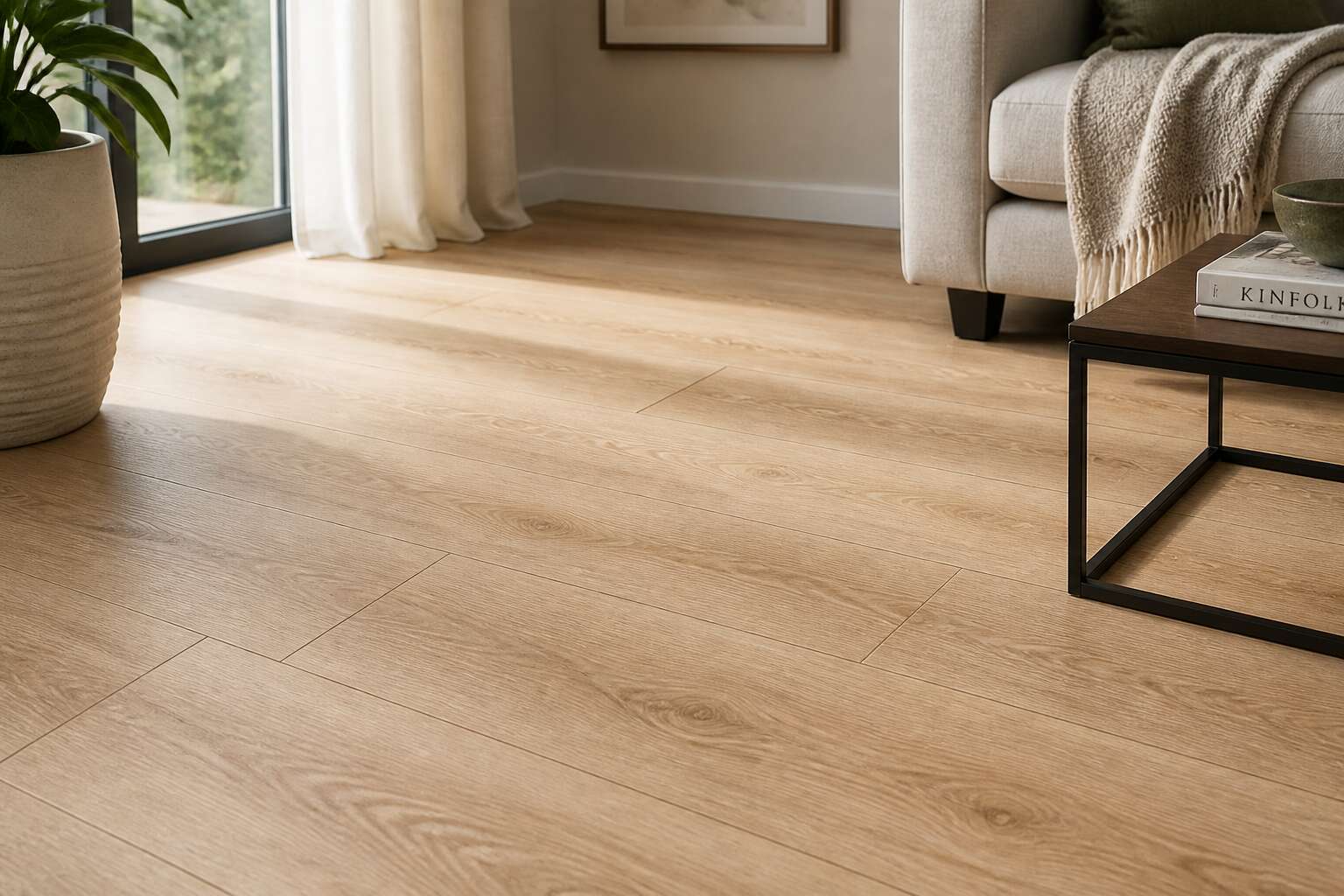
The 5mm Thickness Explained
What Does 5mm Actually Mean
One would think five millimetres are scarcely worth discussing, yet they dictate how your living room feels. In South African homes, laminate flooring 5mm is the leanest common choice, and its thinness affects every step.
That slim core raises your floor height by less than a centimetre, which solves clearance problems near door frames. But it also removes any cushioning for subfloor irregularities. A dip that a 10mm plank tolerates becomes a visible soft spot, a sight I have seen often. Practical tradesmen I know enjoy the lighter boxes:
- A stack fits easily in a small car boot
- Cutting with a jigsaw is effortless
- Carrying up stairs strains no one
The acoustic trade-off is immediate! Footsteps on such a slim profile echo rather than thud, a detail that becomes noticeable in upstairs rooms.
Comparison to 7mm, 8mm, and 10mm
In South Africa, the market share tells a story: laminate flooring 5mm holds roughly 30% of local sales, a figure that surprises many first-time buyers. The visual comparison to thicker boards is where the divide becomes clear. A 7mm plank offers a slightly denser core, while 8mm and 10mm profiles provide additional impact resistance for high-traffic areas.
The acoustic signature shifts noticeably with each millimetre. A 5mm core produces a sharper, more hollow sound underfoot, whereas an 8mm board deadens the noise through its compressed fibre content. This matters if you are laying over concrete, where sound travels further. For installations on wooden joists, the thinner profile actually adheres better to slight undulations, reducing the risk of flexing.
Subfloor preparation becomes non-negotiable with the slimmer option. A 10mm plank might forgive a 3mm depression, but laminate flooring 5mm exposes every flaw, demanding a smooth screed before fitting. The trade-off appears in the pocketbook. Prices for the 5mm tier undercut thicker rivals significantly, and the lighter weight transforms logistics:
– One person can haul an entire room’s supply from a bakkie to the second floor
– A 1.5m skip length fits through awkward doorways without binding
– Trim cuts take seconds with a sharp utility knife, not just a jigsaw
Sightlines alter subtly too. The reduced height makes a transition strip nearly invisible against a tile floor, a neatness that thicker boards cannot achieve. For rental properties or quick flips, the cost savings outweigh the durability concerns, provided you accept the shorter lifespan. The question is not whether 5mm beats 10mm in absolute terms, but whether the budget and the room’s foot traffic demand such bulk in the first place.
Weight and Handling Benefits
Lift a box of laminate flooring 5mm and you’ll immediately see why solo installers prefer it. The weight difference between a 5mm pack and a 10mm pack is significant. That matters when you’re hauling stock from a supplier to a third floor without a lift. Your forearms, lower back, and patience all benefit from this lighter load.
The handling advantages go beyond muscle fatigue. Thin boards flex enough to ease them around corners and into low clearances where a rigid plank will not fit without force. For a professional installer, the speed gain is real: fewer breaks, fewer strained shoulders, more square meters laid per hour.
- Carry more boxes per trip
- Position planks with minimal effort
- Reduce the risk of overexertion injuries
Laminate flooring 5mm may lack the heft of premium tiers, but that same lightness makes it easy to manage.
Where 5mm Fits in the Market
Few shoppers enter a Johannesburg flooring store asking for laminate flooring 5mm by name. Yet I have yet to meet a landlord who regrets choosing it. It serves first-time homeowners, rental property managers, and renovation flippers who want a clean floor at a sensible price.
This profile suits specific rooms:
- Bedrooms and studies with low foot traffic
- Rental units where turnover is frequent
- Temporary styling before selling a home
Retailers in Cape Town and Durban stock 5mm close to underlay and aluminium trims, knowing that deadlines and budgets drive many renovations. The product earns its place by staying simple, affordable, and available!
Installation and Subfloor Requirements
Preparing the Subfloor
The subfloor determines the result of your laminate flooring 5mm installation. A smooth surface is essential. Thin planks like laminate flooring 5mm have zero tolerance for bumps. A 2mm ridge can cause movement and noise. The concrete base in your Johannesburg home must be checked for apparent defects.
Give the subfloor a meticulous clean. Then test for moisture. Lay a plastic sheet, tuck the edges, and wait a day. Condensation reveals moisture. Grind high spots and fill low spots with a self-leveling compound. Inspect the cracks closely.
Follow a sequence.
- Check the surface within a 2mm tolerance over one metre.
- Repair any gaps with a suitable filler.
- Install a moisture barrier.
Get the base right, the floor will settle quietly. Get it wrong, you will hear every step. That is an accent you do not want in your living room.
Choosing the Right Underlayment
Before installing laminate flooring 5mm, inspect the subfloor. It must be clean, dry, and flat. Uneven areas cause the planks to flex and the locking systems to fail. Use a straightedge to check for high spots and low spots.
The floor needs to be flat within 3mm over a distance of one metre. This is the standard for laminate flooring 5mm. If the subfloor is uneven, fix the dips first. Use a self-leveling compound for low areas. Grind down any high spots. A smooth surface is essential.
Once the subfloor is flat, address moisture. Install a moisture barrier. This is a plastic sheet that stops dampness from reaching the laminate. Lay the sheet across the entire floor. Overlap the seams by 200mm. Tape the seams with a suitable tape.
The 5mm thickness matters for the underlay. You can buy laminate with the underlay attached. This is pre-attached foam. It saves installation time. If the underlay is separate, roll it out over the moisture barrier. Use the correct underlay for a 5mm board. The underlay provides cushioning and sound reduction.
Let the laminate acclimatise. Store the unopened boxes in the room for 48 hours before you start. Keep the boxes flat. The temperature in the room should be around 18 degrees Celsius.
When you start, leave a gap. The gap is for expansion. The floor moves with changes in humidity. Keep a 10mm gap around the entire perimeter of the room. Use spacers to maintain this gap against the walls. Cover the gap later with skirting boards.
Install the planks row by row. Offset the end joints. The offset should be at least 300mm between rows. This makes the floor stable. Tap the planks together with a tapping block. Use a pull bar for the last plank in each row.
The 5mm thickness is standard for domestic laminate. It is strong for homes but not for heavy commercial use. Check the AC rating on the box. An AC3 rating is good for most homes. The higher the AC number, the more durable the surface.
Work methodically. Cut the last plank to fit, remembering the 10mm gap. Use the offcut to start the next row, provided it is long enough for the offset. This reduces waste.
Finish the installation by removing the spacers. Fit the skirting boards to cover the expansion gap. Do not fix the skirting to the laminate floor. Fix them to the wall. This allows the floor to move freely.
Check the final surface. Walk over the floor and listen for hollow sounds. These indicate a gap between the subfloor and the laminate. The gap needs fixing. Take the floor apart and address the subfloor issue. The floor will only last if the base is perfect.
Acclimation Time and Climate
Acclimatisation is a period of stillness, not a formality. For laminate flooring 5mm, the unopened boxes need 48 hours in the room. This matters in South Africa, where coastal humidity and Highveld dryness are opposites. The boards must adapt before the locking system bears the weight of walking.
The room temperature should sit near 18 degrees Celsius. During installation, maintain that. The laminate responds to the environment. A 10mm expansion gap around the perimeter allows movement. The gap narrows in winter and widens in summer. That is the floor breathing.
Climate factors for this floor:
- Moist coastal air demands a damp proof membrane beneath the planks.
- Dry Highveld winters shrink boards when indoor humidity drops.
- Load shedding creates temperature swings, and the expansion gap absorbs them.
Floating Installation Techniques
Floating installation is a sequence of rotations, not a contest. Laminate flooring 5mm behaves well when you respect the profile. Insert the plank at a slight angle against the previous row, then pivot it down flat. The click is real. Always check the entire edge, not just the visible corner, before moving on.
Subfloor flatness must be treated as a fact, not an opinion. The standard is no more than 3 millimetres of deviation under a 2 metre straightedge. With a thinner core, there is no bulk to mask a low spot. That dip in the concrete works its way through the joint and becomes a flexing seam after a few weeks.
Perform the floating work in this strict order:
- Align the first row against the longest wall, with the groove facing into the room.
- Raise each following plank to the correct angle and rotate it down until the lock fully engages.
- Run a tapping block along the whole edge to seat each short seam evenly.
That method produces the tight fit that laminate flooring 5mm requires to act as a single surface course, regardless of its modest build.
Glue-Down Methods
Glue-down installation changes the relationship between the floor and the slab. The adhesive becomes the fifth layer of a system that includes the core, the decor paper, the wear layer, and the locking profile. With laminate flooring 5mm, the thin gauge means the bond quality determines the final acoustics. A full spread of adhesive prevents the hollow sound that haunts poorly bonded thin planks.
The trowel’s teeth leave a serrated heartbeat across the concrete. Use a 2mm notched trowel for consistent coverage. Press each plank into the wet adhesive and rotate your palm across the surface to expel air pockets. The mechanical lock still gets engaged first, but the glue serves as the permanent sentry.
1. Roll out the adhesive in manageable sections, roughly 300mm wide per plank row.
2. Work from the longest wall outward, pressing each plank immediately.
3. Check for adhesive bleed at the seams and wipe it away.
The adhesive cures into a rubbery memory that holds the plank in place. When the central heating kicks in, the thin core expands and contracts as one body. A floating floor would shift and flex, but a glued 5mm surface admits no compromise. The secret lies in the timing. Apply the adhesive and lay within the open time. Wait too long, and the bond becomes brittle. Work too fast, and the planks slide. This method rewards a measured pace, a steady hand, and a respect for the chemical clock ticking beneath your knees.
Transition and Trim Options
In South African homes, we demand the subfloor for laminate flooring 5mm be flat to within 3mm over a 2m straightedge. Concrete slabs pass after proper curing. Timber subfloors demand extra scrutiny. A loose board transfers motion directly to the thin planks above.
Subfloor requirements for 5mm are strict:
- Moisture content below 12% for concrete, below 10% for timber.
- Expansion gaps of 8 to 10mm along every fixed object.
- No surface undulation greater than 2mm over 1m.
Transitions handle the height difference where laminate flooring 5mm meets a tiled floor or a carpet edge. A reducer strip sits nearly flush with the adjoining surface. A saddle threshold covers doorways. For stairs, a nosing profile guards the front edge. Choose aluminum for longevity or wood to match the decor. The transition seals the expansion void and protects plank ends from moisture and impact.
Durability and Performance Factors
Wear Layer and Abrasion Resistance
Laminate flooring 5mm typically achieves an AC3 or AC4 rating, resisting 1,000 to 2,000 abrasion cycles. The wear layer is the aluminium oxide coating on top of the décor. For a 5mm plank, this coating measures 6 to 12 mils. It protects against scuffs, pet claws, and sliding furniture. The abrasion resistance directly correlates to the AC rating, not the board thickness.
Performance also involves protection from spills and UV fading. A dense core underneath prevents dents from heavy objects. For a compact 5mm plank, the surface density works with the wear layer to absorb impact.
- Higher AC4 indicates more aluminium oxide per square metre.
- Embossed texture hides light scratches from daily use.
- Sealed joints block moisture from weakening the wear layer.
Impact and Indentation Resistance
A dropped cast iron pot can end a floor’s life in a single second. For laminate flooring 5mm, survival depends on core density measured in kilograms per cubic metre. Quality 5mm planks pack between 850 and 900 kg/m³ into that slim profile. That density determines how impact energy disperses across the plank.
The surface layer takes the first hit. Beneath it, the high-density fibreboard absorbs the rest. Indentation resistance is not a single number. It changes with the bluntness of the object, the speed of the impact, and the temperature of the room. A rolling office chair exerts different pressure than a stiletto heel. Laminate flooring 5mm handles both differently.
Factors that influence indentation performance:
– Core density grade
– Thickness of the decorative layer
– Subfloor flatness beneath the plank
Supporting the joints matters too. A 5mm plank spanning an uneven subfloor flexes more, and that flex cracks the locking system long before the surface dents.
Moisture and Humidity Tolerance
Water is patient. It finds the tiny gaps between planks, works under the surface, and waits. In South Africa, where coastal humidity and summer storms create constant moisture pressure, laminate flooring 5mm lives on the edge. The dense core, packed between 850 and 900 kg/m³, offers genuine resistance. But no density rating defeats a standing puddle left overnight.
The vulnerability is at the joints and edges. A 5mm plank has less material to lose before it cups, and the locking system suffers first when moisture seeps below. The right underlayment with a vapour barrier is not optional here. Indications of trouble remain subtle at first, then destructive:
– Swelling visible at the short ends
– Planks rising along the long edges
– A musty smell that no cleaner removes
Expansion gaps matter more in this climate. Thinner flooring responds faster to humidity swings, so leaving the correct perimeter space prevents the floor from pushing against the walls.
Sound and Insulation Properties
Footsteps echo differently in a room with laminate flooring 5mm. The thinner profile does not absorb low frequency thuds like a thicker board might. That is why urban dwellers in Johannesburg or Durban, sharing walls in close quarters, notice the acoustic character immediately.
Sound performance depends on the floating installation, the underlayment, and the ceiling construction below. Thermal insulation follows a similar logic. The dense core resists temperature changes, yet the floor surface stays cool in winter. A simple listing of what influences this is enough to set expectations:
- Plank density and weight
- Locking system tightness
- Subfloor flatness
- Room furnishings and wall coverings
Each element changes how sound and cold travel through the space. In a country of mixed climates, these properties matter more than absolute thickness alone.
Maintenance and Cleaning Best Practices
Under the weight of a bookshelf or a heel crossing a room, laminate flooring 5mm reveals its true character. Core density, not the decorative layer, dictates how long planks endure South Africa’s abrasive household grit. A tight locking system prevents joints from flexing and grinding. A looser fit invites premature wear along the edges.
Cleaning practices alter the lifespan of this floor as much as installation steps. Dry sweeping or vacuuming with a soft brush removes sand and dust that scrape the wear layer. Moisture requires rationing; a damp microfiber mop, wrung until barely damp, outperforms a heavy wash. On a 5mm profile, standing water seeps quickly toward the core, where it does lasting damage.
Several indicators reveal whether the floor is holding up or quietly failing:
- gaps between locked planks
- a dull haze along busy paths
- edges darkening after wet mops
These cues arrive slowly, but they announce the true cost of a thin floor.
Cost, Value, and Budget Considerations
Price Per Square Foot Analysis
The price per square foot for laminate flooring 5mm often undercuts thicker options, yet the savings come with a trade-off. In South Africa, where budgets tighten against demanding climates, this thinner profile becomes a calculated choice. Landlords and renovators frequently compare quotes, finding the initial outlay significantly lower for the 5mm category.
- Raw material costs shrink with reduced thickness.
- Transport and handling become cheaper per volume.
- Installation time drops, lowering labour fees.
But value extends beyond the purchase price. A cheaper floor can demand more preparation, especially on subfloors hiding imperfections. The true cost per square meter emerges only after underlayment and levelling are factored in. Many purchasers discover that for laminate flooring 5mm, the price advantage fades when they invest in extra moisture barriers for coastal regions.
Comparing Costs with Thicker Options
Working with a strict budget for a rental unit makes the lowest price per square meter deeply appealing. Choosing laminate flooring 5mm cuts initial material costs sharply compared to 8mm or 10mm boards. Yet the real value calculation extends beyond the checkout counter.
Consider the lifespan. In a quiet home office, 5mm offers several solid years. But in a hallway, the thinner core flexes more, leading to seam wear sooner. Replacing a floor after four years instead of ten changes the actual cost significantly.
- Assess the room’s foot traffic honestly.
- Include underlayment costs; they are not optional.
- Calculate a replacement cycle based on family habits.
Practical homeowners make laminate flooring 5mm work by accepting its limits. It delivers a clean, modern look now without a heavy financial commitment. The value is strong when matched to the right space, rather than expecting it to outlast a thicker option.
Long-Term Replacement and Repair Costs
Laminate flooring 5mm presents an attractive first invoice, but the long-term bill is what matters. In shared households, the zones around doorways and chair wheels take the hardest punishment. A dropped cast-iron pan can fracture the core, and the thin board has no reserve layer to absorb that shock. Repairing a single plank is usually impossible.
Replacement costs multiply quickly. Before you commit, weigh these factors:
- Whether the original batch will still be sold in three years
- How the subfloor’s micro-movement impacts the thin joints
- If the locking system stays intact after a few dismantles
Each determinant shapes the true expense. Low initial price fades when the full lifecycle cost appears. One might find that laminate flooring 5mm is a short-lived investment. Setting aside a monthly reserve for future repairs makes the budget honest.
Return on Investment for Rental Properties
Landlords in Johannesburg to Cape Town face a simple equation when flooring rental units. The laminate flooring 5mm option whispers affordability at first glance, yet the return on investment depends on tenant behaviour and turnover frequency. A property that sees a new family every twelve months demands a floor that survives the chaos of moving furniture and daily life.
Here is what separates a shrewd investment from a costly mistake:
1. Verify the wear layer thickness for scratches from dragging bags.
2. Inspect the locking system since repeated moisture exposure weakens joints.
3. Compare the cost against potential vacancy days lost to repairs.
Budget considerations for rentals carry hidden burdens. Tenant damage deposits rarely cover the full replacement of a floor across multiple rooms. The laminate flooring 5mm price might tempt you, but the balance sheet tells a fuller story. Replacement board mismatches and installation labour drain profits quickly. A worn floor in a rental also lowers perceived property value, affecting future rental income. Consider the long game; a modest upgrade now prevents a financial headache later. The true expense includes disposal of old flooring and contractor time during turnover. Weigh the initial savings against the inevitable wear. The smart investor calculates the lifespan, not just the price tag. Every square metre tells a story of return, and the laminate flooring 5mm chapter requires careful reading before you sign the invoice.
Design, Aesthetics, and Room Compatibility
Visual Texture and Wood Grain Replication
The visual trickery of laminate flooring 5mm is often underestimated. A thin profile does not mean a flat or lifeless surface. Modern embossing techniques create a tactile grain that follows the printed pattern with unsettling accuracy. You can feel the subtle ridges of oak or the smooth, almost waxy surface of a eucalyptus board without ever sacrificing the thin build.
That texture changes how a room behaves. A deep, brushed wood grain catches raking light and hides the tiny imperfections of a less-than-perfect subfloor. In a South African highveld sun, this makes a real difference.
Some grains I find particularly effective in small spaces:
– A sawn timber effect with a knotty, open pore structure
– A hand-scraped finish with subtle wear lines
– A low-gloss satin surface that mimics aged plank flooring
These patterns pull the eye outward, making a compact room feel wider. Conversely, a tight, vertical grain adds a formal height that suits a study or a narrow passage. The key is to match the visual depth of the board to the light your room receives, not just the colour palette. It is a quiet design decision, but one that visitors will sense immediately.
Plank Widths and Format Variations
Plank width dictates the visual rhythm of a room. A laminate flooring 5mm in a wide 240mm format pulls the gaze along the horizontal, making a narrow Johannesburg dining room feel more expansive. The thin profile does not weaken this effect; the width carries the visual weight without the bulk of thicker substrates.
Narrow strips around 130mm produce a busy, traditional cadence that suits a study. I have laid herringbone patterns using this laminate flooring 5mm, and the low profile makes the angled joints appear sharper, almost skeletal.
- Wide planks of 200mm or more for open living areas
- Medium planks of 160mm to 190mm for standard rooms
- Narrow planks under 150mm for compact or period interiors
Long boards exceeding two metres reduce transverse joints, creating an unbroken grain line in a Cape Town bedroom.
Color Trends and Light Reflection
South African homes enjoy over 2,500 hours of annual sunshine, so light reflection deserves attention before you purchase. A laminate flooring 5mm with a matte sheen scatters daylight softly, while a gloss finish amplifies it. The thickness does not influence this; the wear layer and decor paper determine the optical character. Even at 5mm, the visual result rivals thicker products.
Current colour trends lean toward European oaks with subtle grey undertones. These complement the exposed brick and concrete finishes common in Johannesburg lofts. Pale, bleached ash suits rooms with limited direct light.
For coastal homes in Durban, consider:
- Warm, sandy neutrals that hide everyday dust
- Muted taupes that pair with natural fibre furniture
- Low-sheen surfaces that reduce glare from ocean light
Dark walnut retains a following in formal dining rooms, but it absorbs sunlight. Balance it with pale walls.
Suitability for High-Traffic Areas
Design in a 5mm plank is not a compromise. The decor paper carries the grain, the texture, the quiet semblance of timber. In a Johannesburg passage where feet move from morning to midnight, laminate flooring 5mm endures. The surface tells the story. The thickness merely bears it.
For high-traffic zones, consider the room’s personality. A lounge that hosts Sunday braais demands a finish that hides scuffs. A rental corridor needs neutrality. The 5mm profile suits both, though the subfloor must be true.
- Open-plan kitchens tolerate the format well
- Bedrooms accept it without complaint
- Halls with constant footfall require proper underlayment
Durban’s humidity and Johannesburg’s dust behave differently on this surface. In my experience, the slim build remains a sensible option for rooms that face daily punishment, provided the installation respects the floor beneath.
Underfloor Heating Compatibility
Roughly 12% of South African homes have underfloor heating. The design of a 5mm laminate involves heat absorption. The narrow laminate flooring 5mm means less wood to absorb warmth, so the heat transfers faster. Most systems run at 27 degrees. Below that threshold, the surface grain stays intact. At peak performance, you get a practical floor, not thin imitation.
Room compatibility is the second filter. A laminate flooring 5mm suits a bedroom with controlled cable systems, but behaves differently in an open-plan area that catches afternoon sun. The board tolerates both. The true issue is the thermostat, not the plank.
In my experience, underfloor heating demands a dense, thin underlay. The 5mm profile gives that without distorting the floor height. When installed correctly, the space warms evenly, and the laminate holds a flat, calm finish.



0 Comments